To make a gluten free cheesecake, replace the wheat crust with crumbs from certified gluten-free graham crackers, keep the cream cheese filling the same, bake at 300°F for 55 to 60 minutes until the center jiggles slightly, cool it in the turned-off oven for one hour, and chill overnight before slicing. That is the complete recipe in one paragraph.
Most cheesecake problems come from three mistakes: a wheat crust, too much air in the batter, and rushed cooling. This guide fixes all three. You will find exact ingredients for a 9-inch springform pan, step-by-step instructions, a troubleshooting table for cracks, and a checklist that keeps every ingredient under the FDA limit of 20 parts per million (ppm) of gluten. This recipe was last tested and updated in October 2026.
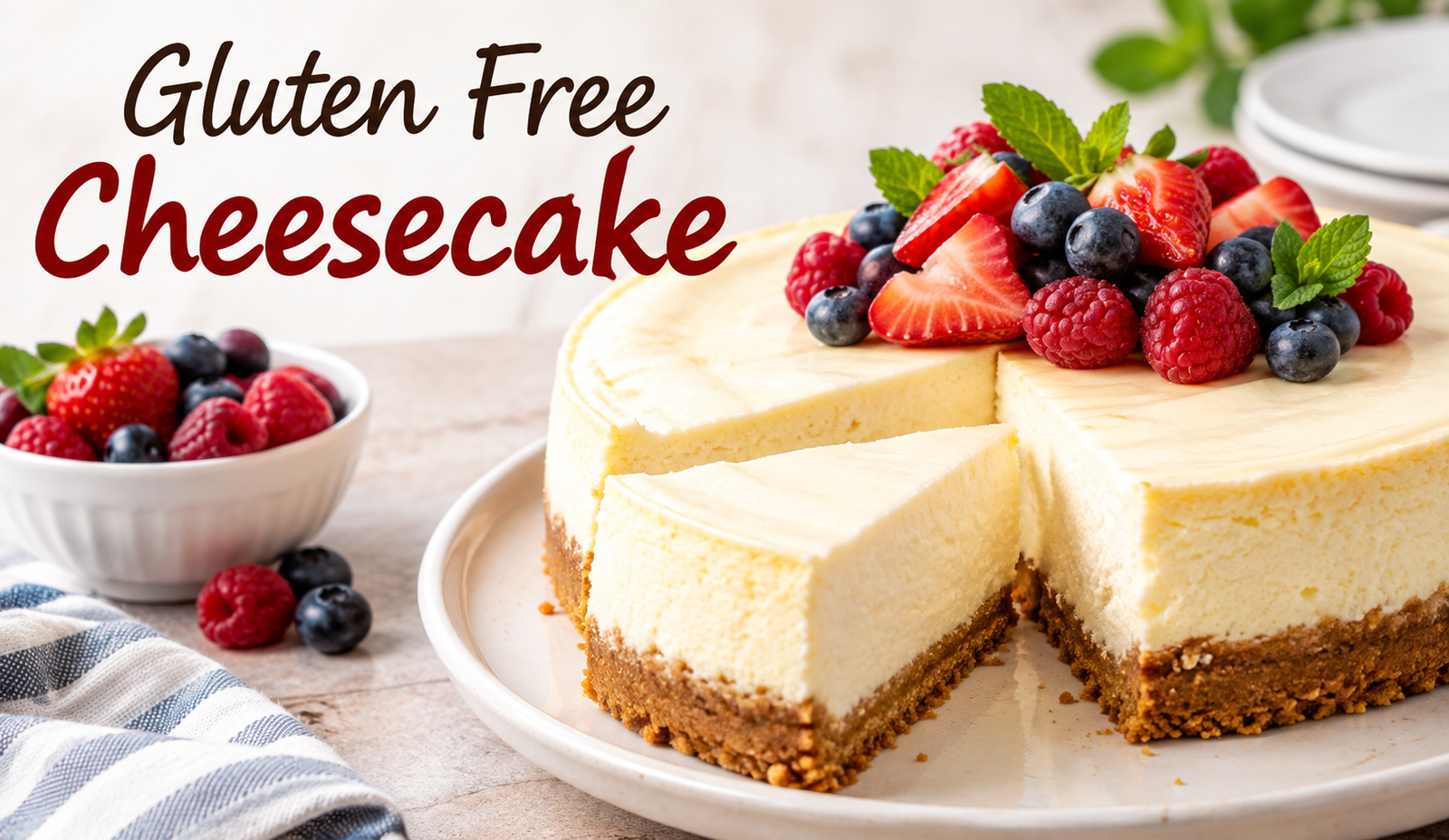
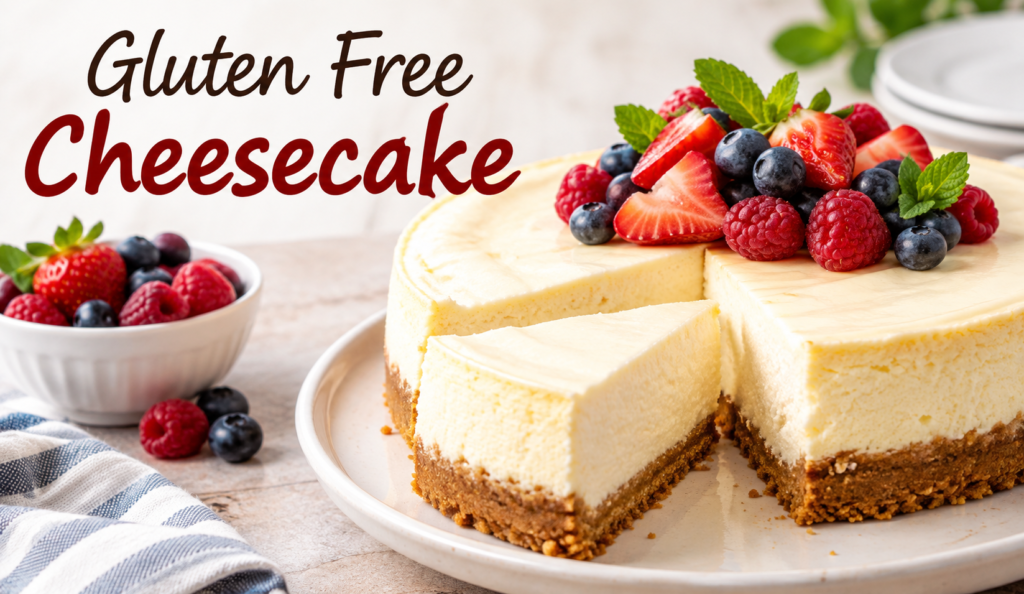
Caption: A creamy gluten free cheesecake with a golden gluten-free crust, sliced and ready to serve.
What Makes a Cheesecake Gluten Free?
A cheesecake is gluten free when every ingredient contains fewer than 20 parts per million (ppm) of gluten. Gluten is the protein found in wheat, barley, and rye. The FDA set the 20 ppm limit in a final rule published in August 2013, and manufacturers had until August 2014 to comply. The rule applies to the claims “gluten-free,” “no gluten,” “free of gluten,” and “without gluten.”
Which Cheesecake Ingredients Contain Gluten?
The crust is the main source. Standard graham crackers use wheat flour. Cookie crusts such as digestive biscuits and shortbread also use wheat flour. Some recipes add a spoonful of all-purpose flour to the filling as a stabilizer, so always check the filling recipe too.
Which Cheesecake Ingredients Are Naturally Gluten Free?
The filling contains no gluten in its basic form. These ingredients are naturally gluten free:
- Cream cheese
- Granulated sugar
- Eggs
- Sour cream
- Lemon juice
- Cornstarch
- Vanilla extract
The 5-Item Hidden-Gluten Audit for Cheesecake Bakers
Packaged ingredients can add gluten after manufacturing, so audit these before you bake:
- Canned pie fillings: some cherry and blueberry fillings use wheat-based thickeners.
- Caramel and fudge sauces: flavored syrups sometimes contain barley malt.
- Cookie crumbs sold in bulk bins: bins carry cross-contact from wheat products.
- “Wheat free” without “gluten free”: wheat-free does not guarantee barley and rye are absent.
- Flavored extracts and syrups: check the label, since barley-derived flavoring exists.
The US Food Allergen Labeling and Consumer Protection Act (FALCPA) requires manufacturers to declare wheat on the label, but it does not cover barley and rye. A “gluten-free” claim on the package is the only reliable proof that the 20 ppm limit is met.
Is Cheesecake Usually Gluten Free?
No. Traditional cheesecake is usually not gluten free because the crust contains wheat flour from graham crackers or cookies. The filling is typically gluten free. A crustless cheesecake, or one made with certified gluten-free crumbs, removes the gluten source.
What Do You Need to Make a Gluten Free Cheesecake?
The recipe below fits a 9-inch springform pan and yields 12 slices.
| Detail | Value |
|---|---|
| Pan size | 9-inch springform |
| Yield | 12 slices |
| Crust bake | 350°F for 10 to 12 minutes |
| Filling bake | 300°F for 55 to 60 minutes |
| Oven rest | 1 hour, oven off |
| Room temperature cooling | Until the pan is no longer warm |
| Refrigerator chill | 4 hours minimum, overnight preferred |
| Water bath | Not required |
Crust Ingredients
- 1 3/4 cups gluten-free graham cracker crumbs (from an 8 oz box)
- 1 tablespoon sugar
- 1/2 teaspoon cinnamon
- 1 pinch kosher salt
- 4 tablespoons melted butter
Filling Ingredients
- 4 packages (8 oz each) full-fat cream cheese, softened
- 1 cup sugar
- 4 eggs, room temperature
- 1 cup sour cream
- 2 teaspoons lemon juice
- 1 tablespoon cornstarch
- 1 teaspoon vanilla extract
Why Cornstarch Replaces Flour
Cornstarch contains no gluten. One tablespoon limits egg proteins from tightening too fast during baking. Tighter proteins increase surface cracks. The recipe needs no flour of any kind.
Crust Alternatives for Gluten Free Cheesecake
Gluten-free cookies, nuts, and wafers can replace graham crumbs. Examples include gluten-free shortbread, almond cookies, and ground pecans. A pecan crust pressed into a 10-inch springform pan and chilled in the freezer for 15 minutes also works well. If you enjoy experimenting with crusts, our gluten free millionaire caramel slice shows how a shortbread-style base sets firm without wheat.
How Do You Make Gluten Free Cheesecake Step by Step?
Bakers lose most cheesecakes through rushed temperature changes. These steps control each variable.
Step 1: Prepare the Pan and Ingredients
- Remove cream cheese, eggs, and sour cream from the refrigerator 1 to 2 hours before baking.
- Preheat the oven to 350°F.
- Butter the bottom and sides of a 9-inch springform pan.
Step 2: Make the Crust
- Grind the gluten-free graham crackers in a food processor until fine.
- Whisk the crumbs with sugar, cinnamon, and salt.
- Pour the melted butter over the crumbs. Mix until the texture resembles wet sand.
- Press the mixture into the bottom of the pan.
- Bake for 10 to 12 minutes until lightly browned.
- Cool for at least 10 minutes. Keep the oven on.
Crust Coverage Options
A bottom-only crust uses the quantities above. A crust that rises up the pan sides requires double the crust ingredients. Pressing the crumbs about 1 inch up the pan sides gives a classic bakery look.
Step 3: Make the Filling
- Beat the cream cheese and sugar on high for 1 to 2 minutes until smooth.
- Add the eggs one at a time. Scrape the bowl after each egg.
- Add the sour cream, lemon juice, cornstarch, and vanilla.
- Mix on low until just combined.
Overmixing after the eggs go in adds air. Air bubbles rise during baking and split the surface.
Step 4: Bake the Cheesecake
- Pour the filling over the crust. Smooth the top.
- Place the pan in the preheated oven.
- Lower the temperature to 300°F immediately.
- Bake for 55 to 60 minutes. The edges should set. A 2 to 3 inch circle in the center should still move slightly.
- Turn off the oven. Leave the cheesecake inside for 1 hour with the door closed.
Step 5: Cool and Chill
- Run a knife around the pan edge to loosen the cheesecake. Leave it in the pan.
- Cool at room temperature until the pan is no longer warm.
- Cover and refrigerate for at least 4 hours.
- Release the springform ring and add toppings.
The USDA advises refrigerating perishable foods within 2 hours of cooking. Cream cheese and egg-based desserts fall under this guidance.
Why Did My Gluten Free Cheesecake Crack? Troubleshooting Table
A gluten free cheesecake cracks for the same reasons a standard cheesecake cracks. Gluten does not hold a cheesecake together, so removing it does not change the cracking mechanism. Find your symptom in the table below.
| Symptom | Most Likely Cause | Fix |
|---|---|---|
| Single crack down the middle | Overbaking | Pull the cake when the edges are set and the center still jiggles; a center temperature near 150°F also signals doneness |
| Surface puffed up, then sank and split | Too much air in the batter | Mix on low speed after adding eggs and stop as soon as the batter is smooth |
| Crack appeared during chilling | Sudden temperature change | Cool 1 hour in the turned-off oven, then at room temperature before refrigerating |
| Dry, eggy texture with cracks | Oven too hot | Confirm the 300°F setting with an oven thermometer; skip the high-heat start |
| Crack near the pan edge | Cake stuck to the pan | Run a knife around the edge right after the oven rest |
How to Hide a Crack That Already Formed
Toppings cover cracks without affecting taste. Common options are whipped cream, fresh berries, and chocolate sauce. The crack does not change the safety of the cheesecake.
What Is the Cross-Contact Mistake Most Bakers Miss?
Bakers check the crust ingredients and stop there. The larger risk often sits in the kitchen. Cross-contact occurs when gluten-free food touches surfaces, tools, or ingredients that carry gluten particles.
Gluten is hazardous at very low levels. The FDA’s 20 ppm limit equals 20 milligrams of gluten per kilogram of food. The Celiac Disease Foundation states that a strict gluten-free diet is the only treatment for celiac disease.
Where Cross-Contact Happens During Cheesecake Baking
- Shared butter dishes with wheat crumbs from toast
- Cream cheese tubs reused with a knife that touched bread
- Used springform pans with scratches that hold residue
- Food processors that ground wheat crackers before
- Wooden spoons and mixing bowls with porous surfaces
How to Prevent It
- Wash the pan, processor, bowls, and mixer attachments with hot soapy water.
- Line the pan base with parchment paper.
- Use a new, sealed package of butter and cream cheese.
- Choose gluten-free graham crackers with a “gluten-free” label.
- Store the finished cheesecake in a sealed container on the top shelf.
How Long Does Gluten Free Cheesecake Last?
A gluten free cheesecake stays fresh in the refrigerator for up to 5 days when covered. It keeps for up to 1 month in the freezer. Wrap the cheesecake tightly in plastic wrap and foil before freezing. Thaw it in the refrigerator for 8 to 12 hours before serving.
How Do You Adjust the Recipe for Different Pan Sizes?
Pan size changes the batter volume needed. Pan area gives the answer.
| Pan | Area | Recipe multiplier |
|---|---|---|
| 8-inch round | 50 sq in | 0.8x |
| 9-inch round | 64 sq in | 1x |
| 10-inch round | 79 sq in | 1.25x |
| 9 x 13 inch | 117 sq in | 1.8x |
A larger pan produces a thinner layer, so the bake time shortens. A smaller pan produces a taller layer, so the bake time extends. Check doneness by center movement and temperature, not by the clock.
Can You Use a Pie Pan Instead of a Springform Pan?
Yes, if the pie pan is at least 9 inches across and at least 1 1/4 inches tall. A springform pan is not required. Release is harder from a pie pan, so serve slices directly from it.
What Toppings and Variations Work Best?
Topping Options With Quantities
- Fresh strawberries, blueberries, or raspberries with powdered sugar
- 1/3 cup gluten-free caramel sauce with 1/2 cup chopped pecans
- Hot fudge sauce made with gluten-free ingredients
- Whipped cream piped around the edge
Recipe Variations
- Pecan crust: replace graham crumbs with ground pecans and butter.
- Citrus version: add 1 tablespoon of lemon or orange zest to the filling.
- Cherry topping: use a 20-ounce can of cherry pie filling, after verifying the can is gluten free.
- Lightened filling: swap part of the sour cream for plain Greek yogurt; check the yogurt label for a gluten-free claim.
For more ideas, browse our best gluten free desserts guide or the 15 gluten free dessert recipes with exact ratios. If you are buying a slice instead of baking, read how to find a safe gluten free dessert near you.
Frequently Asked Questions About Gluten Free Cheesecake
Is cheesecake gluten free?
Standard cheesecake is not gluten free because the crust contains wheat. The filling usually contains no gluten. A gluten free cheesecake uses certified gluten-free crumbs or a crustless base.
What is gluten free cheesecake made of?
A gluten free cheesecake is made of gluten-free graham cracker crumbs, butter, cream cheese, sugar, eggs, sour cream, lemon juice, cornstarch, and vanilla. Every packaged item must carry a gluten-free label.
Can I use regular graham crackers in a gluten free cheesecake?
No. Regular graham crackers contain wheat flour. They exceed the 20 ppm limit. Use a brand labeled gluten-free instead.
Do I need a water bath for gluten free cheesecake?
No. A water bath is optional. Cornstarch, a 300°F bake, and slow oven cooling control cracking without one. A foil wrap around the pan base protects against leaks if you prefer the extra security.
Why did my gluten free cheesecake crack?
Overmixing, overbaking, and sudden temperature changes cause cracks. Mix on low after adding eggs. Cool the cake in the oven for 1 hour. Chill it only after it reaches room temperature.
How do I know when gluten free cheesecake is done?
The edges are set, and a 2 to 3 inch circle in the center moves slightly. The center firms up as it cools. A center temperature near 150°F also indicates doneness.
Why is the center still jiggly after baking?
A slight jiggle is the goal, not a failure. The residual heat finishes setting the center during the 1-hour oven rest. A fully firm center straight out of the oven usually means the cake is overbaked and will crack.
How long should gluten free cheesecake chill?
Chill it for at least 4 hours. Overnight chilling gives a firmer slice and cleaner cuts. Do not remove the springform ring before chilling.
Can I freeze gluten free cheesecake?
Yes. Freeze the cheesecake whole or in slices for up to 1 month. Wrap tightly in plastic and foil. Thaw in the refrigerator for 8 to 12 hours.
Can I bake gluten free cheesecake in a 10-inch pan?
Yes. Multiply the recipe by 1.25 for a 10-inch pan. Check doneness 5 to 10 minutes earlier because the layer is thinner.
Can I make gluten free cheesecake without graham crackers?
Yes. Use gluten-free cookies, ground nuts, or wafers. Examples include gluten-free shortbread and ground pecans. Mix with melted butter and bake at 350°F.
Can I make this cheesecake crustless?
Yes. Butter the springform pan generously, skip the crust, and pour the filling straight in. Reduce the bake time by about 5 minutes and cool the same slow way.
Is gluten free cheesecake safe for people with celiac disease?
It is safe only when every ingredient is labeled gluten-free and no cross-contact occurs. The FDA limit is under 20 ppm. Clean all tools before baking.
Can I make gluten free cheesecake dairy free?
Dairy-free versions use plant-based cream cheese and sour cream. Texture and bake time differ from the dairy version. Check each product for a gluten-free label.
Conclusion
A gluten free cheesecake needs one change from the classic recipe: a certified gluten-free crust. The filling stays the same. Three controls prevent cracks: low-speed mixing after the eggs, a 300°F bake, and slow cooling in a closed oven.
Safety depends on the kitchen as much as the ingredients. Clean tools, labeled products, and a sealed storage container keep the cake under the 20 ppm limit. Bake it once with these controls, and every slice will cut clean.
Read more about the history and varieties of cheesecake.