In 2026, many home cooks still watch gluten free tortillas split at the first fold. Gluten free tortillas stay flexible when the dough has a gel binder, high water content, and steam trapped right after cooking. Psyllium husk (a soluble plant fiber that forms a gel in water) supplies the binder in most reliable recipes.
This guide explains how to make gluten free tortillas from flour, psyllium husk, water, oil, and salt. It also covers corn tortillas, store-bought safety, and exact fixes for cracking, sticking, and rubbery texture.
Wheat tortillas get their stretch from gluten (the protein network in wheat, barley, and rye). Gluten free flours such as white rice flour, potato starch, and maize flour form no such network. A binder must replace it.
The sections follow the cooking order: ingredients, dough, rolling, cooking, storage, and label checks. Each section names the problem first and gives the fix second. Measurements appear in grams and cups so results stay repeatable.
What Are Gluten Free Tortillas Made Of?
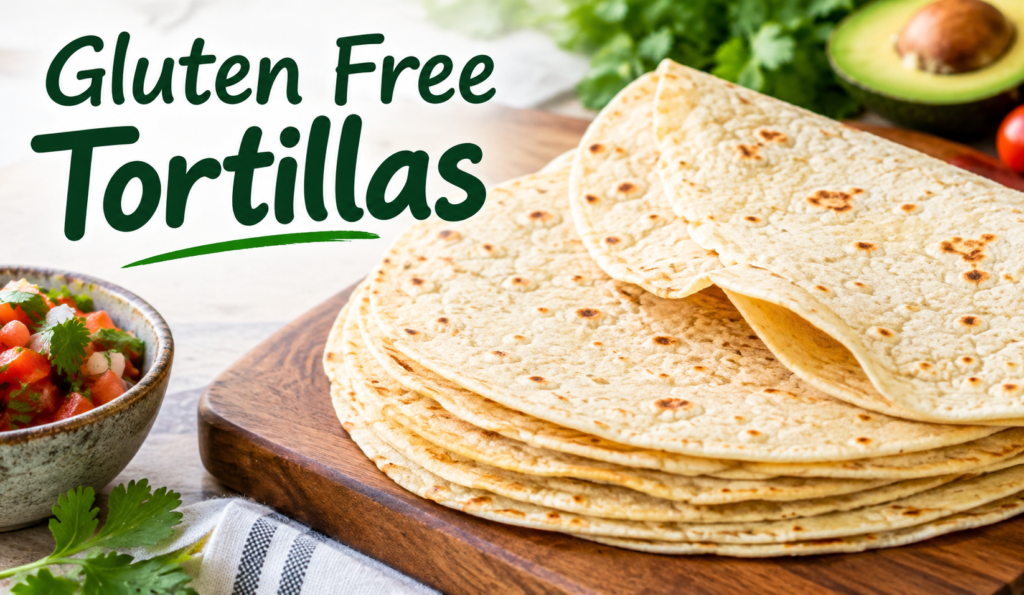
Gluten free tortillas are made from corn masa or from a gluten free flour blend bound with psyllium husk, xanthan gum, or both. Two families exist, and each behaves differently in the pan.
Corn Tortillas
Corn tortillas use masa harina (dried corn dough flour). Producers make it through nixtamalization (soaking corn in water and calcium hydroxide, also called lime). The process began in Mesoamerica and remains standard in Mexico.
Why Corn Masa Needs No Added Binder
Nixtamalization changes the corn so the dough binds on its own. A cook mixes masa harina with warm water and salt, then presses 6 inch (15 cm) rounds. These tortillas suit tacos, tostadas, and enchiladas. They tear when overfilled.
Flour Tortillas
Gluten free flour tortillas copy the larger wheat version, usually 8 to 10 inches (20 to 25 cm) wide. They suit burritos, wraps, and quesadillas. The dough combines rice flour, starches such as potato starch and tapioca starch, a binder, water, oil, and salt.
A cook who swaps wheat flour for rice flour one to one gets a dry, crumbly dough. Rice flour has no stretch and absorbs water differently. The binder and extra water close that gap.
How Do You Make Gluten Free Tortillas at Home?
Mix psyllium gel into a plain gluten free flour blend with oil and salt, rest the dough, roll each piece to 1 to 2 mm, and cook 45 to 60 seconds per side. One batch makes 12 tortillas of 9 inches (23 cm).
Ingredients
- 360 g (3 cups) plain gluten free flour blend, plus extra for dusting
- 24 g (5 tablespoons) whole psyllium husk, or 20 g psyllium powder
- 480 g (2 cups) warm water
- 50 g (¼ cup) neutral oil
- 9 g (1½ teaspoons) fine salt
Plain means the blend contains no baking powder or other raising agents.
Instructions
- Whisk the psyllium husk into the warm water for 20 seconds. A gel forms.
- Whisk the flour blend and salt in a large bowl.
- Add the oil and gel. Stir until shaggy, then knead for 2 to 3 minutes until springy.
- Cover the dough and rest it for 10 minutes.
- Divide the dough into 12 pieces of about 77 g each. Shape balls and keep them covered.
- Dust the surface with flour blend. Roll each ball to 9 inches (23 cm) and 1 to 2 mm thick.
- Heat a non-stick pan over medium-high heat. Cook one tortilla for 45 seconds, until bubbles form.
- Flip it. Cook for 45 to 60 seconds, until brown spots appear.
- Move each tortilla into a clean, folded towel to trap steam.
Homemade Flour Blend Ratio
A blend of 50% white rice flour, 30% potato starch, and 20% maize flour by weight works well. For 360 g, that means 180 g rice flour, 108 g potato starch, and 72 g maize flour. Weigh every ingredient, because cup measures vary between brands.
Why Do Gluten Free Tortillas Crack or Tear?
Gluten free tortillas crack when the dough is too dry, rolled too thick, or missing a gel binder. Each cause has a measurable fix.
Low Hydration
Gluten free flours and starches absorb water differently by brand. This recipe uses about 1.3 parts water to 1 part flour by weight. A 2020 study by Mayara Belorio and Manuel Gómez Pallarés found that hydration level strongly shapes gluten free bread quality. The same study reported that psyllium and xanthan gum behaved alike for volume and weight loss.
If the dough crumbles, add 1 tablespoon of water at a time. If it sticks, rest it 10 minutes, then add flour blend by the tablespoon.
Wrong Psyllium Form
Whole husk and powder are not interchangeable by weight. Use 20 g of powder where a recipe lists 24 g of whole husk. Powder forms lumps faster and can tint the dough grey or purple. Blond psyllium husk (a pale variety) adds little color or flavor.
Fixing a Lumpy Gel
Pour the husk into the water while whisking, not the reverse. Use an immersion blender for powder. Discard a gel that forms hard brown lumps.
Rolling Too Thick
A tortilla thicker than 2 mm puffs poorly and stays doughy. Roll between two sheets of parchment, or inside a zip bag cut open along three sides, to stop sticking.
A tortilla press works with the same bag method. Presses often give thick 6 to 7 inch rounds, so roll lightly afterward to reach 9 inches.
The Double Binder Mistake That Turns Dough Into Rubber
Many gluten free flour blends sold in 2026 already contain xanthan gum, guar gum, or psyllium. Adding the full 24 g of psyllium on top of that over-binds the dough.
The result is a heavy, elastic dough and tortillas that feel chewy and stiff. A 2024 study from the Universitat Politècnica de València found that extra psyllium raised dough elasticity but also increased crumb gumminess and crust hardness. The same team found that removing xanthan gum gave a softer, less gummy crumb.
Consider a baker who uses a measure-for-measure blend that lists xanthan gum. The baker adds the full psyllium amount, and the tortillas turn out rubbery. Cutting the added husk from 24 g to 18 g and testing one tortilla corrects the ratio.
Four Label Checks Before Mixing
- Look for xanthan gum in the ingredient list.
- Look for psyllium, guar gum, or cellulose gum in the same list.
- Confirm the word “plain,” which signals no baking powder.
- Confirm a gluten free claim on the front of the pack.
If the blend already contains a binder, reduce the added psyllium and test a single tortilla first.
How Do You Cook Gluten Free Tortillas So They Puff?
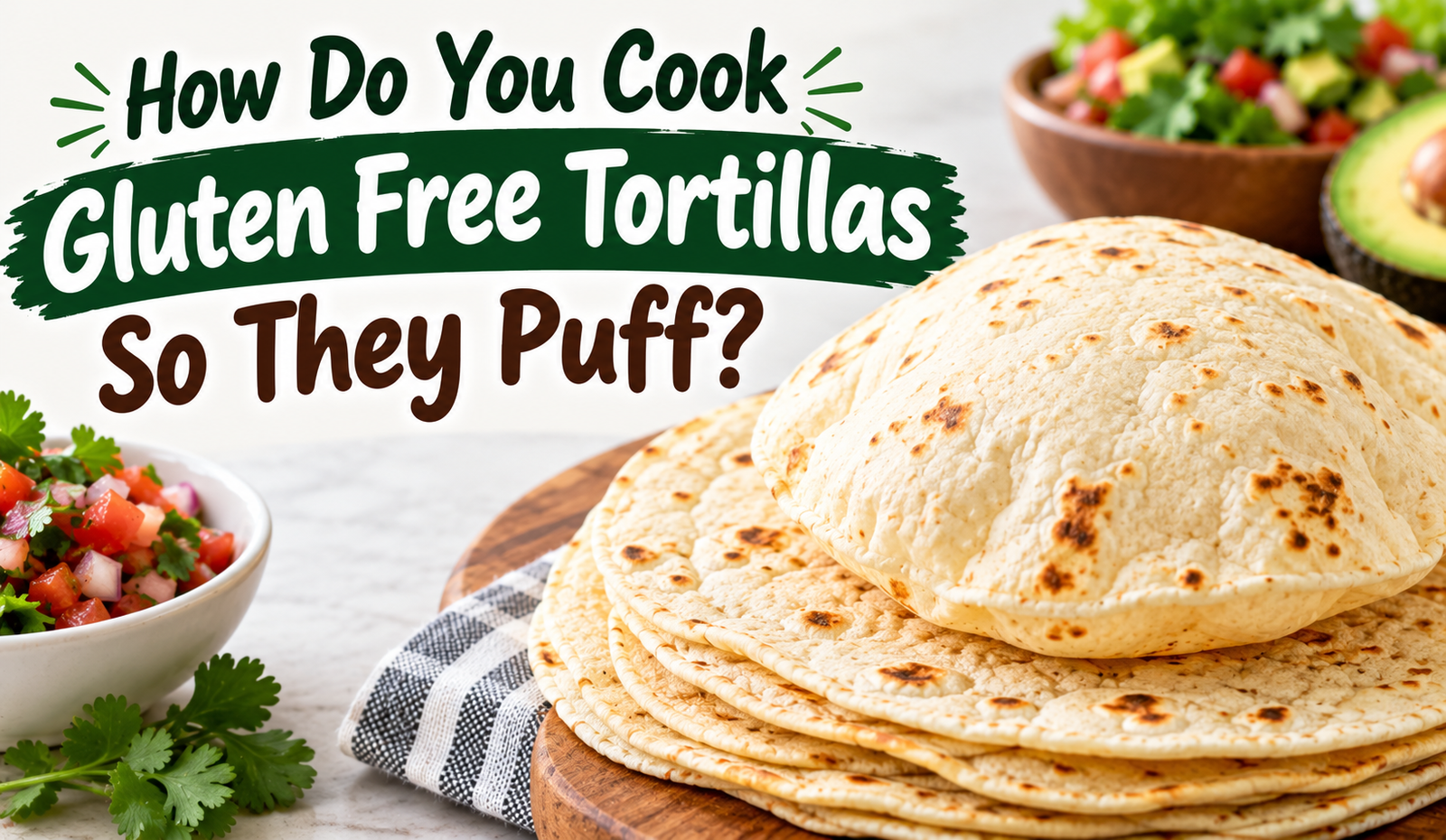
Cook each tortilla in a preheated non-stick pan over medium-high heat, then steam it in a covered towel. Three variables control puffing: pan, heat, and thickness.
Pan Choice
Non-stick pans release thin dough easily and give even browning. Cast iron works when fully preheated, but thin dough can stick and dry out faster. Stainless steel works for experienced cooks who preheat well.
Heat Test
Flick a drop of water onto the pan. It should sizzle at once. Low heat dries the tortilla before it puffs and leaves it stiff. High heat scorches the surface before the center cooks.
Steam After Cooking
Steam softens the tortilla as it cools. A cook who leaves tortillas uncovered on a rack finds stiff edges within minutes. A folded towel, a lidded container, or a tortilla warmer prevents that.
What Is Psyllium Husk in Gluten Free Baking?
Psyllium husk is a soluble fiber from the outer coating of Plantago ovata seeds. It forms a gel in water. In gluten free dough, the gel holds starch particles together and adds stretch. Recipes often use 5 to 7 percent of flour weight. Powdered husk needs about 15 to 17 percent less than whole husk.
Are Corn Tortillas Gluten Free?
Corn tortillas are naturally gluten free because corn contains no gluten. Cross-contact can still occur when factories or kitchens process wheat tortillas on the same equipment. Some brands also add wheat flour to improve flexibility. Check for a gluten free label, which requires less than 20 parts per million of gluten in the United States.
How Do You Know a Store-Bought Gluten Free Tortilla Is Safe?
A store-bought tortilla is safe for celiac disease when it carries a gluten free claim and meets the FDA limit of less than 20 parts per million (ppm) of gluten. The label is the only reliable signal.
What the FDA Rule Requires
The FDA published its final gluten free rule in August 2013 and required compliance from August 5, 2014. Labeled foods must contain less than 20 ppm of gluten. The same limit applies to claims such as “no gluten,” “free of gluten,” and “without gluten.” The rule governs voluntary labeling, so a manufacturer chooses whether to make the claim. Labels in 2026 still rely on this standard.
Why the Label Matters
Research led by Alessio Fasano of the Center for Celiac Research at MassGeneral Hospital estimated that about 1 in 133 Americans has celiac disease. The American Academy of Pediatrics puts the figure for children between 1 in 80 and 1 in 300.
FDA sampling from July 2015 to August 2016 found that more than 99.5 percent of labeled products met the 20 ppm requirement.
Consider a parent who buys wraps for a child with celiac disease. The package says “made with ancient grains.” That phrase says nothing about gluten, because spelt and khorasan wheat are wheat varieties.
Ingredients That Signal Gluten
- Wheat flour
- Spelt
- Barley malt
- Rye flour
- Triticale
How Do You Store, Freeze, and Reheat Gluten Free Tortillas?
Store cooled tortillas in an airtight bag for 2 to 3 days at room temperature, or freeze them for up to 3 months. Gluten free starches stale faster than wheat starch, so airtight storage matters.
Freezing
Stack cooled tortillas with parchment between each one. Place the stack in a freezer bag and press out the air. Thaw wrapped at room temperature for a few minutes.
Reheating
Spritz a tortilla with water. Cook it in a covered pan over medium heat for 45 to 60 seconds per side. A microwave works too: wrap the tortilla in a damp paper towel and heat for 15 to 20 seconds.
Making the Dough Ahead
Wrap the dough tightly and refrigerate it for a few hours. Airtight wrapping prevents a dry skin from forming.
Quick Troubleshooting Table
| Problem | Likely Cause | Fix |
|---|---|---|
| Cracks when folded | Dough too dry or too thick | Add 1 tbsp water; roll to 1 to 2 mm |
| Dough sticks | Too wet, or powder psyllium | Rest 10 minutes; dust with flour blend |
| Rubbery texture | Double binder | Cut added psyllium; check blend label |
| Grey or purple tint | Dark psyllium brand | Switch to blond psyllium |
| Does not puff | Low heat or thick dough | Use medium-high heat; roll thinner |
| Stiff after an hour | No steam | Wrap in a towel; store in a bag |
Gluten Free Tortillas FAQs
Are flour tortillas gluten free?
No. Standard flour tortillas contain wheat flour, which contains gluten. Only tortillas made from corn or from a gluten free flour blend, with a gluten free label, fit a gluten free diet.
What is the best flour for gluten free tortillas?
A plain blend of white rice flour, potato starch, and maize flour works well. A measure-for-measure blend also works with less added psyllium. Almond flour does not work, because the dough turns crumbly.
Can I make gluten free tortillas without psyllium husk?
Ground flaxseed or xanthan gum can replace psyllium, but the texture changes. Test a half batch first. Corn masa tortillas need no binder at all.
Why are my gluten free tortillas hard?
Hard tortillas usually come from overcooking, thick dough, or missing steam. Cook 45 to 60 seconds per side and wrap each tortilla in a towel immediately.
Why are my gluten free tortillas not puffing?
Low heat, thick dough, and a small pan prevent puffing. Roll to 1 to 2 mm and use a preheated, large non-stick pan. Some blends puff less even when everything else is correct.
Can I freeze gluten free tortillas?
Yes. Freeze cooked tortillas with parchment between them for up to 3 months. Thaw them wrapped, then warm each one in a covered pan.
How do I keep gluten free tortillas from breaking when I roll them?
Roll between parchment or a cut-open zip bag. Keep the dough covered, and rest it 10 minutes before dividing. A dough that feels slightly sandy after rolling handles best.
Can I use a tortilla press?
Yes. Line the press with a cut-open zip bag or parchment to stop sticking. Roll lightly afterward if the rounds come out thick or small.
Are gluten free tortillas vegan?
The recipe above is vegan, because it uses no eggs or dairy. Check the flour blend label, since some blends contain milk powder or egg.
How many gluten free tortillas does one batch make?
One batch makes 12 tortillas of 9 inches (23 cm). Halve every ingredient for 6 tortillas. Scale the water by weight, not by volume.
Can I make the dough ahead of time?
Yes. Wrap it tightly and refrigerate it for a few hours. Knead it briefly before dividing and rolling.
Conclusion
Reliable gluten free tortillas depend on three controls. The dough needs a gel binder and about 1.3 parts water to 1 part flour by weight. The flour blend label decides how much psyllium to add, since double binding makes rubber. Steam after cooking keeps the tortilla soft.
Weigh the ingredients, roll thin, and cook on a hot pan. A tortilla that folds on the first try comes from controlled ratios, not luck.
Learn more about the history of the tortilla.