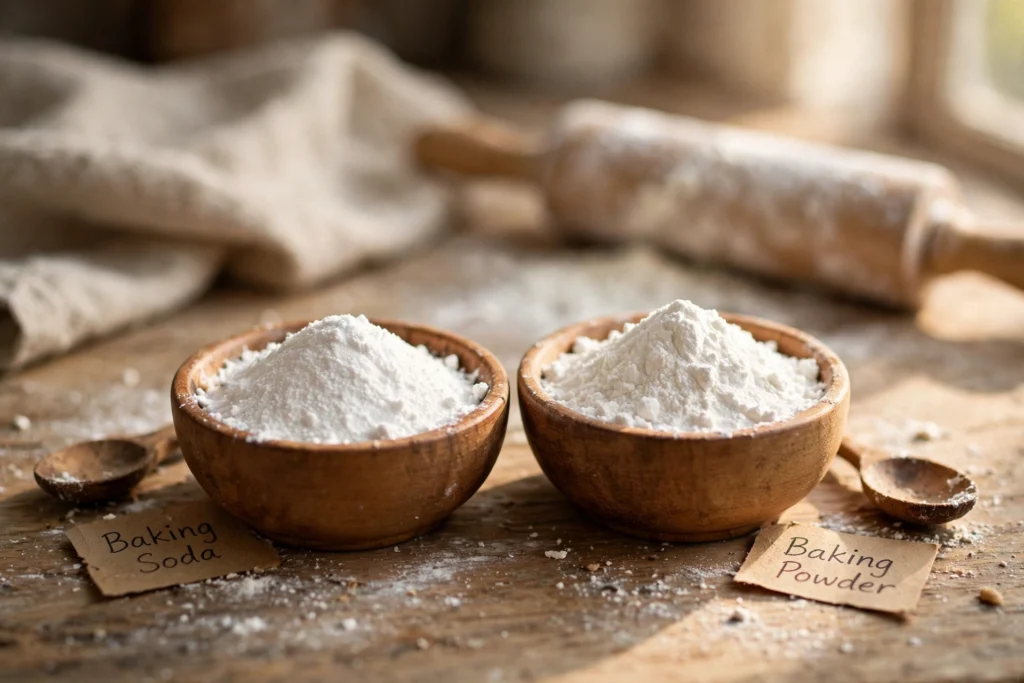
Difference Between Baking Soda and Baking Powder
The difference between baking soda and baking powder comes down to one thing: acid. Baking soda is pure sodium bicarbonate and needs an added acid to rise. Baking powder already contains both a base and an acid, so it rises on its own. As of October 2026, both remain pantry staples worldwide.
Mix them up and your cake can fall flat or taste bitter. The difference between baking soda and baking powder decides the rise, the texture, and even the flavor. In gluten-free baking the stakes are higher. Rice and oat flours have no gluten structure to hold gas bubbles. This guide shows what each one does and when to use which. It covers safe swaps and the best brands for celiac-safe kitchens.
What Is Baking Soda, Exactly?
Baking soda is pure sodium bicarbonate. It is a single mineral compound with a high, alkaline pH. When it meets moisture plus an acid, it reacts fast and releases carbon dioxide gas. That gas forms bubbles, and the bubbles make dough and batter rise.
The reaction starts the second the soda gets wet. This speed is the heart of the difference between baking soda and baking powder. You must get the pan into the oven quickly, or the gas escapes and your bake falls flat.
Common acids that wake baking soda up include:
- Buttermilk and plain yogurt
- Lemon juice and vinegar
- Honey and molasses
- Natural cocoa powder (not Dutch-processed)
- Brown sugar and cream of tartar
Baking soda is about three to four times stronger than baking powder. That is why recipes use tiny amounts, often just half a teaspoon. Too much soda leaves a bitter, soapy taste that no frosting can hide.
What Is Baking Powder, Exactly?
Baking powder is a mix, not a single ingredient. It contains sodium bicarbonate plus one or two dry acids and a starch buffer. The buffer, usually cornstarch or potato starch, keeps the acid and base from reacting in the tin.
Most cans sold today are double-acting. The first acid, often monocalcium phosphate, reacts when the powder gets wet. The second acid waits until the batter gets hot in the oven. Common ones include sodium acid pyrophosphate and sodium aluminum sulfate. This two-stage rise is a key part of the difference between baking soda and baking powder.
Single-acting powder exists too. It reacts once, when wet, so you must bake the batter right away. Almost every supermarket brand, including Clabber Girl and Rumford, is double-acting because it forgives slow bakers.
Leavening agents are big business. A USD Analytics report from November 2024 valued the global baking powder market at $4.8 billion in 2024. It forecasts $7.4 billion by 2032. Home baking and gluten-free demand keep pushing that number up.
What Is the Main Difference Between Baking Soda and Baking Powder?
Baking soda is pure sodium bicarbonate and needs an external acid to activate. Baking powder contains baking soda plus its own acid, so it works with any liquid. Soda reacts once and fast, while double-acting powder reacts twice. That is why soda suits acidic batters and powder suits neutral ones.
The table below sums up the difference between baking soda and baking powder at a glance.
| Feature | Baking Soda | Baking Powder |
|---|---|---|
| Inside the tin | Pure sodium bicarbonate | Soda plus acid and starch |
| Needs to work | Moisture and an acid | Moisture only |
| Rise style | One fast reaction | Two slower reactions |
| Strength | About 3 to 4 times stronger | Gentler and more forgiving |
| Best use | Acidic batters | Neutral batters |
| Taste risk | Bitter or soapy if too much | Neutral taste |
| Swap rule | Cannot replace powder alone | Can replace soda at 3 times the amount |
Which One Is Stronger, and Why Does It Matter?
Baking soda wins on strength. It is roughly three to four times stronger than baking powder as a leavener. One teaspoon of soda gives about the same lift as three teaspoons of powder. This ratio matters because baking is chemistry, not guesswork.
Picture a home baker doubling the soda “for extra rise.” The cake rises fast, then collapses. The crumb tastes metallic and soapy. The extra soda never found enough acid to neutralize it, so the leftover base ruined the flavor.
Strength also affects browning. Baking soda raises the pH of batter, and a higher pH speeds up browning. That is why soda-based cookies turn deep golden, like many of our best gluten free desserts. This strength gap is one more part of the difference between baking soda and baking powder. Baking powder stays closer to neutral, so cakes keep a paler, even color.
Why Do Some Recipes Call for Both?
Many great recipes use both leaveners, and the reason is balance. The recipe has an acid, like buttermilk or yogurt, that needs neutralizing for flavor. Baking soda handles that job and adds lift at the same time.
But the acid alone may not create enough lift for a tall, tender crumb. Baking powder adds a second, controlled rise without changing the flavor. The two work as a team: soda tames the tang, powder builds the height.
Buttermilk pancakes and banana bread are classic examples. Our gluten free banana loaf relies on this exact pairing for a moist crumb that holds for days. If a recipe lists both, do not drop one. Each has a separate job. Getting this team right is the practical side of the difference between baking soda and baking powder.
Can You Substitute One for the Other?
This is where the difference between baking soda and baking powder turns into a real kitchen problem. Most ruined bakes come from ignoring it. Here are the safe rules.
You can replace baking soda with baking powder, but not the other way around. Use three times as much powder as the soda called for. If the recipe needs one teaspoon of soda, use three teaspoons of powder.
Expect a flavor shift. Baking powder brings its own acid, so the recipe’s acid stays unneutralized. Buttermilk pancakes made this way taste tangier. You can soften the tang with a simple swap. Use regular milk instead of tangy buttermilk.
Going the other direction fails without help. Baking soda alone cannot replace baking powder because it has no acid partner. The batter will taste bitter and barely rise.
How Do You Turn Baking Soda Into Baking Powder?
You only need one extra pantry item: cream of tartar. Mix two parts cream of tartar with one part baking soda. For one teaspoon of homemade powder, mix one third teaspoon of soda. Add two thirds teaspoon of cream of tartar.
Use the mix right away. It has no starch buffer, so it starts reacting the moment it gets damp. This trick saves a bake in an emergency. For planned baking, a proper can of powder works better.
Are Baking Soda and Baking Powder Gluten Free?
Baking soda is naturally gluten free because it is a single mineral compound. Most baking powder is naturally gluten free too, since it uses cornstarch or potato starch. Still, a few brands use wheat starch or shared lines. For celiac disease, choose a labeled or certified gluten-free brand and check the current label.
Why the Difference Between Baking Soda and Baking Powder Matters More in Gluten-Free Baking
Wheat flour contains gluten, a stretchy protein network that traps gas and holds a bake up. Gluten-free flours have none of that structure. Gas escapes faster, so the leavener must work harder and smarter.
Double-acting baking powder is the quiet hero of gluten-free baking. Its second lift in the oven keeps pushing the batter up while starches set. That extra push can mean the difference between a fluffy crumb and a dense, gummy brick.
Baking soda still has a place in gluten-free recipes with acids. Our gluten free bread guide and gluten free donuts recipe both lean on careful leavening for texture. The rule stays simple: match the leavener to the batter, and measure with care.
The Gluten-Free Safety Checklist for Both Leaveners
Three label terms matter, and they are not the same. Naturally gluten free means the ingredient itself contains no gluten. Labeled gluten free means the maker meets the FDA limit. That limit is less than 20 parts per million of gluten, set in a rule from August 2013. Certified gluten free means a third party, such as the Gluten-Free Certification Organization (GFCO), tested and audited it.
Baking soda is almost always safe because it is one pure compound. Baking powder needs a closer look. Its starch buffer is usually cornstarch or potato starch, both gluten free. But some products use wheat starch, and vague terms like “modified food starch” deserve a second read. Shared factory lines can also add cross-contact risk.
Cross-contact is real even in a tiny tin. Scooping from a bulk bin with a shared spoon can transfer flour dust. At home, keep your leaveners in sealed containers away from wheat flour. Never double-dip a measuring spoon into both. This safety checklist reflects labels and brands available in October 2026.
Safer Brand Picks as of October 2026
Bob’s Red Mill sells a GFCO-certified gluten-free baking powder made in a dedicated allergen-free facility. Clabber Girl offers a GFCO-certified gluten-free double-acting powder that uses cornstarch. Rumford is aluminum-free and labeled gluten-free, using monocalcium phosphate with non-GMO cornstarch. Otto’s Naturals makes a grain-free baking powder with cassava starch for corn-sensitive bakers. If you have celiac disease or another medical condition, check with your doctor or a registered dietitian first. Always check the current label too, because formulas change.
Beyond Celiac reports that about 1 in 133 Americans has celiac disease. That is roughly 1% of the population, and up to 83% are undiagnosed. With numbers that high, choosing a certified leavener is a small step that protects a lot of people.
Your Muffins Fell Flat? Your Tin Is Probably the Real Culprit
Here is the mistake almost nobody talks about. Knowing the difference between baking soda and baking powder means little if both tins are dead. Baking powder loses strength within 6 to 12 months of opening. Moisture sneaks in and starts the reaction early. Baking soda lasts longer in a dry cupboard, but it absorbs fridge odors and clumps over time.
Test your powder before you bake. Drop one teaspoon into a third of a cup of hot water. Fresh powder fizzes hard right away. Weak or no fizz means the tin belongs in the trash.
Test your soda with vinegar. Stir half a teaspoon into two tablespoons of vinegar. A lively fizz means it still works. A lazy bubble or nothing at all means it has lost its power.
Store both in airtight containers in a cool, dry spot, never above the stove. Write the opening date on the lid with a marker. This thirty-second habit saves more bakes than any fancy technique. Few recipes ever warn you about it.
Frequently Asked Questions
What is the difference between baking soda and baking powder in simple terms?
Baking soda is one ingredient, pure sodium bicarbonate, and needs an acid to work. Baking powder is baking soda plus a dry acid and starch, so it works with any liquid. Soda reacts once and fast; most powder reacts twice, when wet and when heated.
Can I use baking soda instead of baking powder?
Not directly. Baking soda needs an acid partner that the recipe may not have. Your bake will taste bitter and stay flat. You can only make the swap if you add your own acid, such as cream of tartar.
Can I use baking powder instead of baking soda?
Yes, with a ratio change. Use three times as much baking powder as the soda called for. Expect a slightly tangier flavor, since the powder will not neutralize the recipe’s acid the way soda does.
Which is stronger, baking soda or baking powder?
Baking soda is stronger, about three to four times stronger than baking powder. That is why recipes call for small amounts of soda and larger amounts of powder. Never swap them one for one. That ratio rule sits at the heart of the difference between baking soda and baking powder.
How much baking powder replaces 1 teaspoon of baking soda?
Use 3 teaspoons of baking powder to replace 1 teaspoon of baking soda. This 3-to-1 ratio keeps the lift about the same. The flavor may shift slightly tangier, so taste and adjust liquids if needed.
What is double-acting baking powder?
Double-acting powder releases gas in two stages. The first release happens when the powder gets wet. The second release happens when the batter heats up in the oven. This gives a steadier, taller rise than single-acting powder.
Why does my baking powder list aluminum?
Some powders use sodium aluminum sulfate as the second, heat-activated acid. It is a standard leavening acid and works well. Noticed a metallic taste? Choose an aluminum-free brand like Rumford or Bob’s Red Mill.
How do I test if my baking powder is still good?
Stir 1 teaspoon into a third of a cup of hot water. Fresh powder fizzes strongly within seconds. Weak fizz or no reaction means it has lost its power and will not lift your bake.
Does baking soda expire?
An unopened box lasts a long time. An open box weakens over months as it absorbs moisture and odors. Test it by stirring half a teaspoon into vinegar. Strong fizz means it still works.
Is baking soda the same as bicarbonate of soda?
Yes. Bicarbonate of soda is simply the British name for baking soda. Both are pure sodium bicarbonate. They work exactly the same way in recipes.
Can I mix baking soda and baking powder together?
Yes, and many recipes do. Soda neutralizes an acid for flavor and adds quick lift. Powder adds a second, controlled rise for height. When a recipe lists both, use both in the given amounts.
Are baking soda and baking powder gluten free?
Baking soda is naturally gluten free as a single mineral compound. Most baking powder is naturally gluten free too, using cornstarch or potato starch as the buffer. For celiac safety, pick a labeled or certified gluten-free brand and read the current label.
Which baking powder brands are best for gluten-free baking?
Bob’s Red Mill and Clabber Girl both offer GFCO-certified gluten-free baking powders. Rumford is aluminum-free and labeled gluten-free. Otto’s Naturals makes a grain-free version with cassava starch. Any of these work well in gluten-free recipes.
Why does my cake taste soapy or bitter?
You likely used too much baking soda, or the soda never met enough acid. Leftover unreacted soda tastes bitter and soapy. Measure carefully, match soda to an acidic ingredient, and get the pan into the oven quickly.
Conclusion
Remember the difference between baking soda and baking powder. Soda is pure sodium bicarbonate and needs an acid. Powder brings its own acid and rises in two stages. Soda is three to four times stronger, so measure with care and never swap them one for one. For gluten-free bakers, double-acting powder earns its place, and a certified gluten-free brand keeps celiac-safe kitchens truly safe.
Check your tins, test for fizz, and match the leavener to your batter. Do that now that you know the difference between baking soda and baking powder. Your next bake will rise exactly the way you pictured it. If you want the chemistry in more depth, read about leavening agents on Wikipedia.