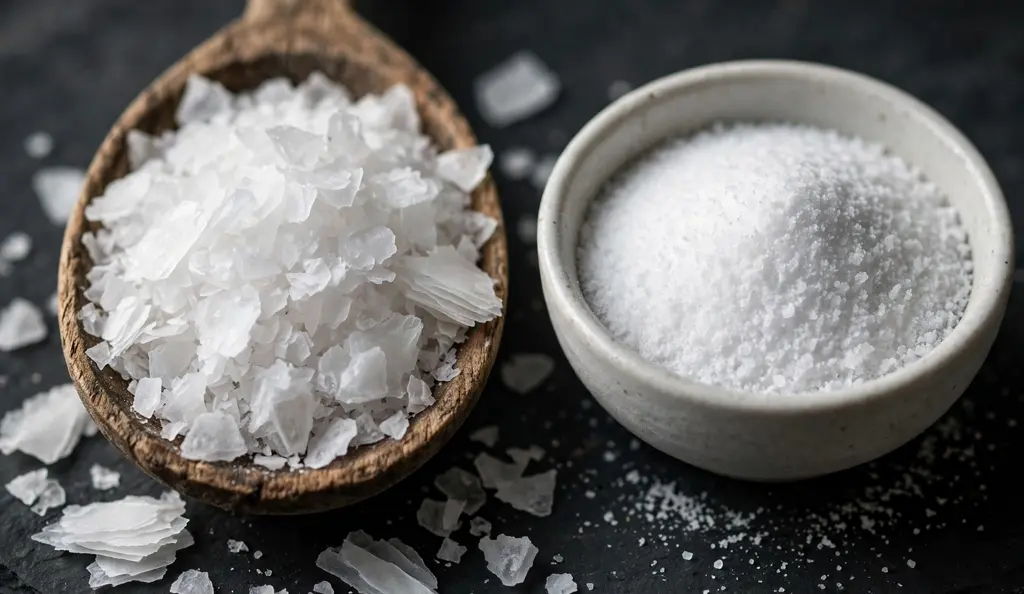
Difference Between Sea Salt and Table Salt
The difference between sea salt and table salt comes down to source, processing, and grain size. Sea salt forms when seawater evaporates in open pans, leaving crystals with trace minerals. Table salt comes from underground mines, gets heavily refined, and usually has iodine and anti-caking agents added. Gram for gram, both have the same sodium.
Walk down any grocery aisle in October 2026 and you will see a wall of salt choices. Fine, coarse, flaky, iodized, pink, smoked. Most cooks grab one without thinking. But the type of salt you pick changes how food tastes, how much iodine you get, and how a recipe behaves in the oven.
This guide breaks down the full difference between sea salt and table salt so you can stop guessing. You will learn where each salt comes from, how they compare on sodium and minerals, exact swap ratios for baking, and what matters for a gluten-free kitchen. By the end, you will know exactly which salt to reach for and when.
What Is the Difference Between Sea Salt and Table Salt?
What is the short answer to sea salt vs table salt?
Sea salt is made by evaporating seawater, so it keeps trace minerals like magnesium, calcium, and potassium, and it has no added iodine. Table salt is mined from underground deposits, refined to remove minerals, and usually fortified with iodine plus anti-caking agents. By weight the sodium is identical. The real differences are texture, taste, and iodine content.
Most salt guides stop at “one comes from the sea, one comes from a mine.” This one does not. Below you will get swap ratios, the iodine trade nobody talks about, and a gluten-free safety check, all with current facts as of October 2026.
Sea Salt vs Table Salt: Side-by-Side Comparison
This table gives you the full difference between sea salt and table salt at a glance.
| Feature | Sea Salt | Table Salt |
|---|---|---|
| Source | Evaporated seawater | Underground salt mines |
| Processing | Minimal, dried by sun and wind | Heavily refined, vacuum evaporated |
| Grain size | Coarse, flaky, or fine crystals | Fine, uniform grains |
| Sodium per teaspoon | About 2,000 to 2,240 mg (fine grind) | About 2,360 mg |
| Sodium by weight | Same as table salt | Same as sea salt |
| Trace minerals | Yes, magnesium, calcium, potassium | Removed during refining |
| Iodine | Almost none | Usually added (iodized) |
| Anti-caking agents | Usually none | Yes, such as calcium silicate |
| Taste | Mild, briny, slightly complex | Clean, sharp, sometimes bitter |
| Price | Higher | Very cheap |
| Best use | Finishing dishes, salads, roasting | Baking, everyday cooking, pasta water |
| Gluten free | Yes, naturally | Yes, naturally |
Where Does Each Salt Come From and How Is It Made?
Every salt on earth started as seawater. The split happens in how humans collect it.
How is sea salt made?
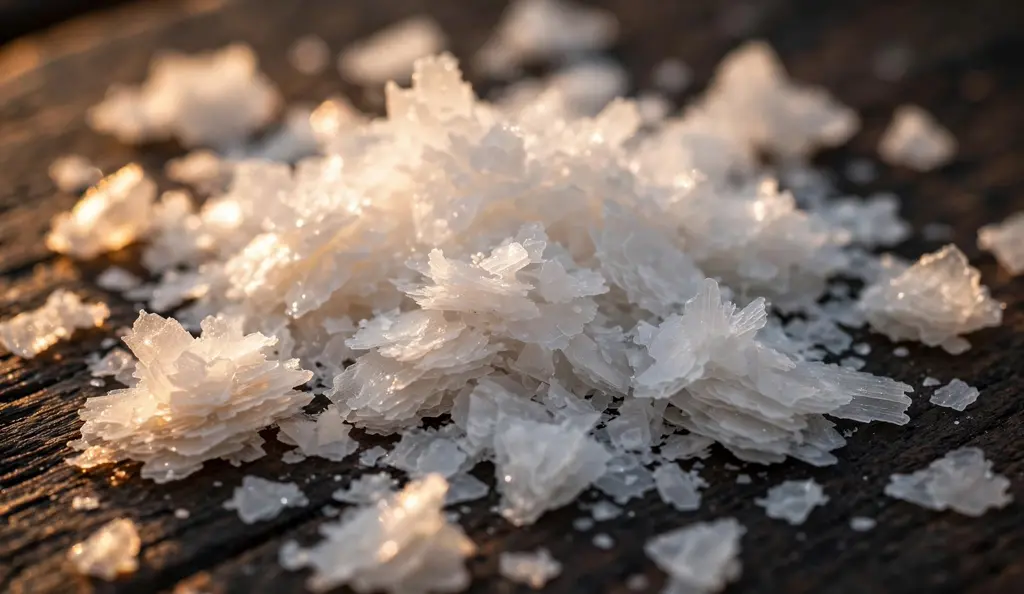
Producers pump seawater into shallow ponds and let the sun and wind evaporate the water. Workers rake the crystals by hand in famous regions like the Trapani salt pans of Sicily or the Guérande marshes of France. Unrefined sea salt keeps trace minerals that give it subtle color and a softer flavor. Refined sea salt gets washed, so it looks pure white but still skips the chemical additives of table salt.
What stays in sea salt?
Evaporation leaves behind tiny amounts of magnesium, calcium, and potassium along with the sodium chloride. These minerals are too small to change nutrition in a real way, but they do change texture and taste. Coarse crystals crunch between the teeth. Flaky crystals, like fleur de sel, dissolve fast on the tongue and give little bursts of flavor.
How is table salt made?
Miners pump water into underground salt deposits, dissolve the salt, and pull up the brine. Factories then boil the brine in vacuum chambers, which makes small, dense, uniform cubes. The process strips out minerals and impurities. Then manufacturers add iodine (as potassium iodide) and anti-caking agents like calcium silicate so the salt pours freely in damp weather.
Why do the additives matter?
The additives do not hurt you, but they change cooking behavior. Anti-caking agents can cloud pickling brine and leave a light sediment in canning jars. Iodine can darken pickles slightly, which is why canning guides suggest non-iodized salt for pickles. For everyday cooking, none of this matters. For precise baking, fine uniform grains are actually a plus.
Is Sea Salt Healthier Than Table Salt?
This is the biggest myth in the salt aisle. Sea salt sounds natural, so people assume it is healthier. Mayo Clinic has pointed out that sea salt and table salt hold the same basic nutritional value. Both are about 98 percent sodium chloride by weight.
The trace minerals in sea salt are real but tiny. You would need to eat dangerous amounts of salt to get meaningful minerals from them. Vegetables, fruit, and whole foods give you far more. As McGill University’s Office for Science and Society explains, a teaspoon of coarse sea salt can hold slightly less sodium than a teaspoon of table salt, simply because big crystals leave air gaps. That is a shape effect, not a health effect.
Here is the number that actually matters. The American Heart Association says most adults should eat no more than 2,300 mg of sodium per day, with an ideal goal of 1,500 mg. In a news report from May 2026, the Association noted that most Americans eat more than 3,300 mg daily. One teaspoon of table salt already holds about 2,360 mg of sodium, according to Morton Salt’s own label. Whichever salt you choose, the winning move is using less of it, not switching types.
One honest line for readers watching their health: if you have high blood pressure or a thyroid condition, check with your doctor or a registered dietitian before changing which salt you use every day.
The Quiet Trade Nobody Mentions: Your Iodine
Here is the angle most sea salt articles skip. When you switch your whole kitchen to sea salt, you quietly give up your main source of iodine.
Iodine is a mineral your thyroid needs to make hormones. Your body cannot make it on its own. For a century, iodized table salt has been America’s quiet public health hero, wiping out the goiter problems that once spread across the Great Lakes region. Sea salt carries almost no iodine unless the label says it is fortified.
This stopped being a small issue recently. A 2025 study in the Journal of Nutrition, widely reported in October 2026, found that about 24 percent of U.S. women and 30 percent of U.S. men aged 14 and older were not getting enough iodine, roughly double the rates from 2001. The CDC’s 2026 Nutrition Report added that women of reproductive age are now on the cusp of mild iodine deficiency. The same October 2026 reporting noted that only 53 percent of table salt sold in U.S. stores is iodized.
The practical fix is simple. You do not need to fear sea salt. Keep a box of iodized table salt in the house and use it for everyday cooking and baking. Save your fancy sea salt for finishing, where its texture shines. You can also get iodine from dairy, eggs, and seafood. If you are pregnant or planning to be, talk to your doctor about iodine, since needs rise sharply in pregnancy.
Does sea salt have iodine?
Plain sea salt has almost no iodine. It forms from evaporated seawater, and natural iodine levels in it are too low to matter. If you rely on sea salt for all your cooking, you should get iodine from iodized table salt, dairy, eggs, or seafood instead. Only buy sea salt labeled as iodized if you want iodine from it, and check the label, because most are not fortified.
Difference Between Sea Salt and Table Salt in Baking and Cooking
Grain size is where the difference between sea salt and table salt bites you in the kitchen. A teaspoon of fine table salt weighs about 6 grams. A teaspoon of coarse sea salt weighs far less, because the big crystals pack loosely with air between them. If you swap spoon for spoon without adjusting, your dish can end up under-salted or over-salted.
Here is the safe rule. Fine sea salt swaps almost evenly with table salt. Coarse sea salt needs more by volume. The most accurate method is a kitchen scale: weigh the salt your recipe asks for and match the grams. Salt is salt by weight, no matter the shape.
Salt conversion chart: table salt to sea salt
Use this chart from MasterClass’s 2026 salt conversion guide when a recipe calls for table salt and you only have sea salt.
| Recipe calls for | Fine sea salt | Coarse or flaky sea salt |
|---|---|---|
| 1/4 tsp table salt | 1/4 tsp | 1/3 tsp |
| 1/2 tsp table salt | 2/3 tsp | 3/4 tsp |
| 1 tsp table salt | 1 1/3 tsp | 1 1/2 tsp |
| 1 Tbsp table salt | 1 Tbsp plus 1 tsp | 1 1/2 Tbsp |
| By weight (best method) | Same grams | Same grams |
Can I replace table salt with sea salt in baking?
Yes, if you adjust for grain size. Fine sea salt works almost spoon for spoon in place of table salt, since the crystals pack similarly. Coarse sea salt needs about one and a half times the volume, and it dissolves more slowly, which can leave crunchy pockets in delicate batters. For cakes, cookies, and bread, either weigh your salt or use fine sea salt. You will get the same rise and the same crumb as with table salt.
Baking is also where salt quietly controls gluten-free dough. Salt tightens the protein network in wheat dough, and in gluten-free baking it firms up starches and slows yeast so flavors develop. My comparison of baking soda vs baking powder shows another spot where small measurement errors change everything. And if a recipe calls for buttermilk, these buttermilk substitutes keep the salt balance right without a store run.
Is Sea Salt Gluten Free? Is Table Salt?
Yes. Plain sea salt and plain table salt are both naturally gluten free. Salt is a mineral made of sodium and chloride. Gluten is a protein found in wheat, barley, and rye. The two have nothing to do with each other. Iodine and standard anti-caking agents added to table salt are also gluten free.
So where is the risk for a gluten-free kitchen? It sits in three places.
When can salt cause a gluten problem?
First, flavored and seasoned salts. Smoked salts, truffle salts, and seasoning blends can contain added flavorings, malt flavoring, or soy sauce powder. Lawry’s Seasoned Salt, for example, is widely reported as gluten free, but recipes change, so always read the current label. Second, bulk bins. Open bins of fancy salt at health food stores can pick up stray grains from shared scoops. Third, salt used at the table in restaurants. A shaker is fine, but a shared dish of finishing salt that bread crumbs fell into is not.
Here is your 30-second label check for any salt product. Read the ingredient list. If it lists only salt (and maybe iodine or calcium silicate), you are safe. If you see the words flavoring, malt, soy, or wheat, put it back or call the maker. For the strictest safety, choose a salt with a certified gluten-free label. The FDA’s gluten-free labeling rule, finalized in August 2013, sets a clear bar: a labeled product must contain under 20 parts per million of gluten.
Plain salt is one of the easiest wins in gluten-free cooking. Use it freely in my Himalayan pink salt recipe guide, sprinkle flaky sea salt over popcorn for movie night, and season your gluten-free bread dough without worry.
Which Salt Should You Use? A Simple Decision Guide
Stop overthinking the salt aisle. Match the salt to the job.
- Reach for fine sea salt or table salt for baking, brines, and pasta water. Fine grains dissolve fast and measure the same every time.
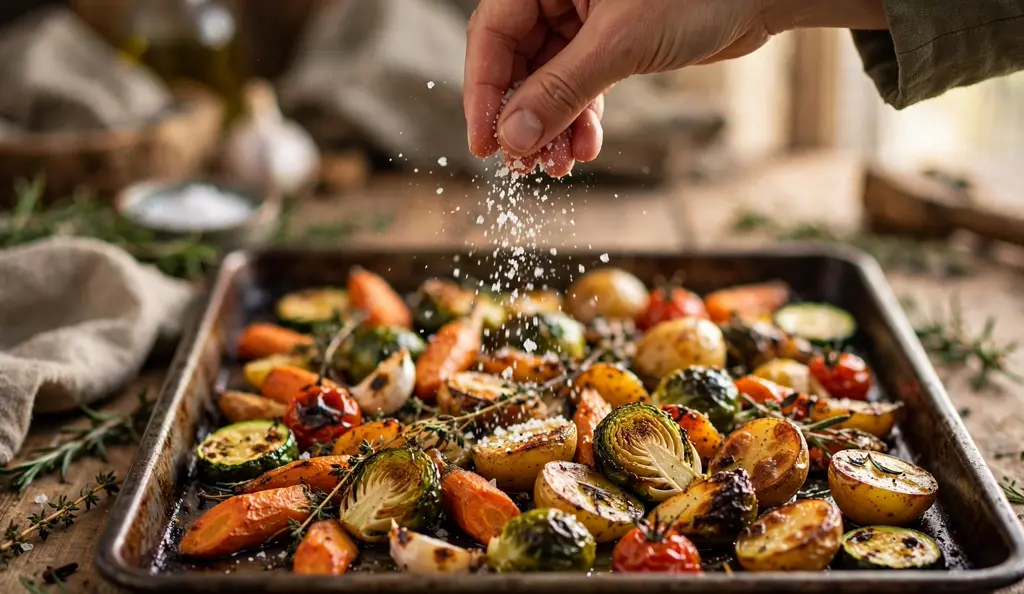
- Reach for coarse or flaky sea salt for finishing. Sprinkle it over roasted vegetables, grilled meat, chocolate desserts, and salads right before serving.
- Reach for iodized table salt for everyday family cooking if sea salt is your main salt. It keeps your iodine intake steady.
- Reach for non-iodized fine salt for pickling and canning. Iodine can darken pickles and anti-caking agents can cloud brine.
- Reach for certified gluten-free labeled salt if you have celiac disease and react to trace cross-contact. Plain salt is naturally safe, but the label removes all doubt.
Picture a home cook in Lahore making gluten-free pizza on a Friday night. She uses fine sea salt in the dough so it dissolves evenly, then finishes the baked pizza with flaky sea salt for crunch. Same meal, two salts, each doing the job it does best.
Frequently Asked Questions About Sea Salt and Table Salt
Does sea salt have less sodium than table salt?
By weight, no. Both are about 98 percent sodium chloride, which means 393 mg of sodium per gram either way. By the teaspoon, coarse sea salt can hold slightly less sodium because the large crystals leave air gaps. Morton Salt’s labels show 2,360 mg of sodium per teaspoon of table salt versus 2,240 mg for its fine sea salt, a small gap caused by grain size.
Can I substitute sea salt for table salt 1:1?
Only if both are fine ground. One teaspoon of fine sea salt is close enough to one teaspoon of table salt for any recipe. For coarse sea salt, use about one and a half teaspoons for every teaspoon of table salt. The safest method is a kitchen scale: match the grams and you cannot go wrong.
Is sea salt healthier than table salt?
Not in any meaningful way. The trace minerals in sea salt exist in amounts too small to change your nutrition. Mayo Clinic notes that both salts share the same basic nutritional value. The healthiest choice is whichever salt helps you use less total sodium, since most adults already eat far more than the American Heart Association’s 2,300 mg daily limit.
Why is iodine added to table salt?
Iodine was added to table salt as a public health measure to prevent iodine deficiency, which causes goiter and thyroid problems. Your thyroid needs iodine to make hormones, and your body cannot produce it. This program wiped out widespread deficiency in the early 1900s. With sea salt use rising, deficiency rates have started climbing again, according to October 2026 reports on the 2025 Journal of Nutrition study.
Is iodized table salt gluten free?
Yes. Iodized table salt is plain salt plus iodine, and neither contains gluten. Gluten is a protein from wheat, barley, and rye. People with celiac disease can use iodized table salt safely. Just keep it to plain salt; flavored versions need a label check.
Do anti-caking agents in salt contain gluten?
No. Common anti-caking agents like calcium silicate, silicon dioxide, and sodium aluminosilicate are minerals, not grains. They contain no gluten. They exist only to keep salt flowing in humid weather. If a label lists only salt and one of these agents, it is gluten free.
Which salt is best for baking?
Fine table salt or fine sea salt. Both dissolve quickly and measure consistently, which matters for even texture in cakes and bread. Avoid coarse salt in delicate batters, since the crystals may not fully dissolve. For bread dough, either fine salt works; salt slows yeast slightly and strengthens the dough so it holds its shape.
Which salt is best for finishing dishes?
Flaky sea salt, like fleur de sel or Maldon-style flakes. The large, thin crystals give a pleasant crunch and little bursts of salinity on the tongue. Sprinkle it over chocolate desserts, roasted vegetables, salads, and grilled meats just before serving. Cooking with it wastes the texture, since heat melts the flakes.
Does sea salt contain microplastics?
Some studies have found tiny plastic particles in sea salt from ocean pollution, because the salt comes straight from seawater. The amounts found are very small, and no health authority has set a safety limit or warned people to avoid sea salt. If this worries you, mined table salt or refined sea salt goes through more processing.
What is the difference between sea salt and kosher salt?
Both can come from seawater or mines; the real difference is crystal shape and additives. Kosher salt has large, flaky crystals and usually no iodine or anti-caking agents. Sea salt ranges from fine to coarse and may be unrefined with trace minerals. In practice, fine sea salt behaves like table salt, while coarse sea salt behaves like kosher salt. Measure by weight when swapping.
Does sea salt taste different from table salt?
Slightly, when used as a finishing salt. Dissolved in soup or dough, no taste test can tell them apart, because both are sodium chloride in solution. Sprinkled on top of food, sea salt’s larger crystals give crunch and a milder, briny note, while table salt tastes sharper and more direct. Texture drives the difference, not chemistry.
How should I store sea salt?
Keep it in a sealed jar in a cool, dry spot. Unrefined sea salt can absorb moisture from the air and clump, since it has no anti-caking agents. A small airtight container near the stove works for daily use. Flaky finishing salts stay crisp longest in a dry cupboard away from steam.
Is pink Himalayan salt the same as sea salt?
No, though both are unrefined. Himalayan pink salt is mined from ancient sea deposits in Pakistan’s Punjab region, while sea salt comes from current seawater. The pink color comes from iron oxide. Nutritionally they are nearly identical, and neither is healthier than table salt. My pink salt recipe guide covers how to cook with it.
Can sea salt go bad?
Pure salt never expires. It cannot support bacteria or mold. Iodized table salt can lose some iodine after very long storage, so makers print a best-by date, but the salt itself stays safe. Flavored salts with added herbs or spices follow the shelf life of those ingredients, so check their dates.
The Bottom Line on Sea Salt vs Table Salt
The difference between sea salt and table salt is about texture, taste, and iodine, not health magic. Both have the same sodium by weight. Sea salt wins for finishing, where its crunch and mild flavor shine. Table salt wins for baking and everyday cooking, where fine grains and steady iodine matter.
As of October 2026, the smartest kitchen keeps both. Use iodized table salt or fine sea salt in your cooking pot, and keep flaky sea salt by the stove for the final sprinkle. Check labels on flavored salts if you eat gluten free. Measure by weight when a recipe must be exact. Do that, and you will never wonder which salt to grab again.
For a deeper look at how common seasonings are made and graded, see the salt article on Wikipedia.