Turron: Is Spanish Nougat Gluten Free?
Yes, traditional turron is naturally gluten free. As of October 2026, classic Jijona and Alicante recipes use only almonds, honey, sugar and egg white, all naturally free of gluten. The risk hides in the wafer sheets, chocolate versions and factory cross-contact, so checking labels matters.
Picture a Spanish Christmas market in December. Wooden stalls stack golden tablets of turrón under strings of warm lights. A shopper snaps a piece of hard Alicante nougat and listens for the crack. Then it melts into honey and toasted almond on the tongue.
In this October 2026 guide you will learn exactly what turrón is, how the main types differ, and which ones are safe for a gluten free diet. You will also learn the wafer trap most articles ignore, how to buy safe bars, how to make simple turrón at home, and how to serve and store it like a Spaniard.
What Is Turron? Spain’s Famous Christmas Nougat
Turrón is a Mediterranean nougat candy made from honey, sugar, egg white and toasted almonds. It is shaped into flat tablets or round cakes. In Spain it is the dessert of Christmas, sold in every supermarket from October through the New Year.
The roots of turrón go back centuries. Spain’s town of Jijona, called Xixona in Valencian, is the historic home of this candy. The Consejo Regulador de Jijona y Turrón de Alicante now guards its quality with a Protected Geographical Indication. That legal stamp means only nougat made in that region, with strict almond minimums, can carry the famous names.
How strict? Under the PGI rules, Turrón de Alicante in the Suprema grade must contain at least 60 percent almonds by weight (AmigoFoods turrón guide, updated October 2026). Jijona Suprema must hit 64 percent. When you break open a good bar, you see more nut than nougat.
The oldest known Spanish turrón recipe comes from the 16th-century Manual de Mujeres, a household handbook. It mixed honey with egg whites, cooked the blend until it hardened when cool, then folded in toasted almonds, pine nuts or hazelnuts. Four centuries later the method is almost the same.
Jijona vs Alicante vs the Rest: Which Turrón Are You Eating?
Two classic types dominate Spanish shelves. Everything else is a modern twist. This quick table shows the difference at a glance.
| Type | Nickname | Texture | Wafer sheets? | Gluten watch |
|---|---|---|---|---|
| Alicante | Turrón duro (hard) | Crunchy, snaps like brittle | Usually yes, top and bottom | Check the wafer line |
| Jijona | Turrón blando (soft) | Soft, crumbly, sliceable | Usually no | Usually safest pick |
| Chocolate turrón | Turrón de chocolate | Firm chocolate bar with nuts | No | Check flavorings and factory lines |
| Yema tostada | Toasted egg yolk | Soft with caramelized top | No | Check candied fruit additives |
| Guirlache | Almond brittle style | Hard caramel crunch | No | Usually simple ingredients |
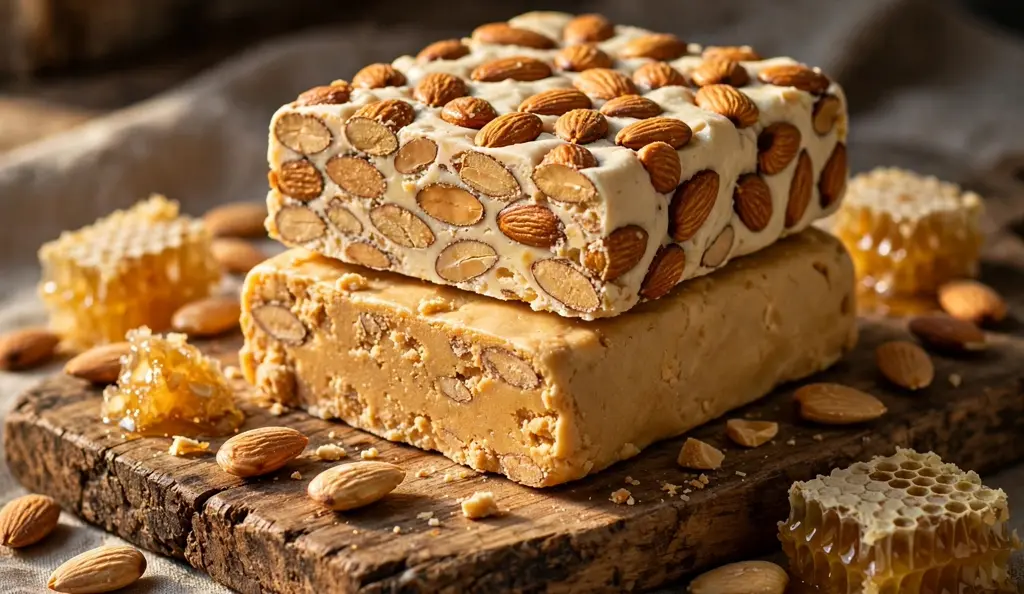
Turrón de Alicante is the hard white bar. Whole toasted almonds sit in a glassy honey nougat. The first bite cracks, then softens into almond and honey. It almost always comes sandwiched between two thin sheets of edible wafer called oblea. Remember this detail. It matters for the gluten question.
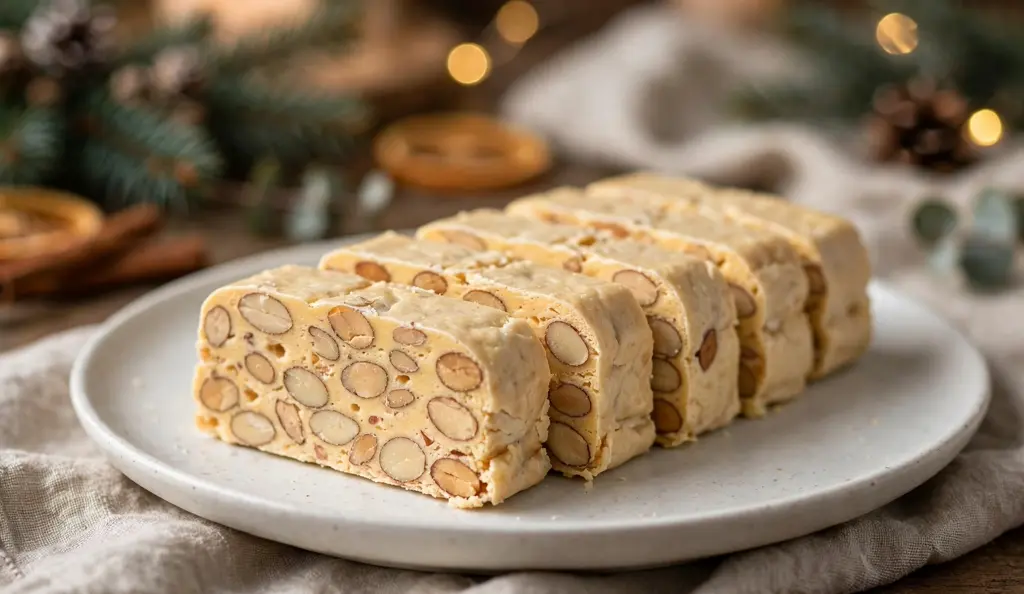
Turrón de Jijona is the soft one and the oldest style. Makers grind the hard nougat with extra almonds until it turns into an oily, tan paste. The result crumbles softly and slices like fudge. Most Jijona bars skip the wafer sheets, which makes them the simplest option for gluten free shoppers.
Chocolate turrón swaps the honey base for a chocolate one, often studded with almonds, puffed rice or candied fruit. It is the most popular modern variety with kids. Puffed rice sounds harmless, but some puffed grains carry malt flavoring made from barley. If you melt chocolate at home, our guide to melting chocolate without seizing shows the right technique for a homemade version.
Is Turron Gluten Free? The Honest Answer
Classic turrón is naturally gluten free. Almonds, honey, sugar and egg white contain no wheat, barley or rye. That is the good news. The honest answer gets longer once you add modern varieties, factory lines and the wafer question.
Is turron gluten free?
Traditional turrón made from almonds, honey, sugar and egg white is naturally gluten free. Flavored kinds like chocolate turrón may add gluten through wafers, malt flavoring or shared factory lines. People with celiac disease should choose bars labeled gluten free and always read the current ingredient list.
Naturally Gluten Free, Labeled Gluten Free, Certified Gluten Free
These three phrases mean different things. Naturally gluten free means the recipe itself has no gluten ingredients. Most classic turrón qualifies. Labeled gluten free means the maker printed a gluten free claim on the pack. In the United States that claim is legally tied to the FDA rule: the food must test under 20 parts per million of gluten (U.S. Food and Drug Administration, August 2013). Certified gluten free means an outside group, such as the Gluten-Free Certification Organization, audited the factory. Certified is the strongest promise.
For everyday snacking, a naturally gluten free bar is fine for many people who avoid gluten by choice. For celiac disease, the safest choice is a labeled or certified bar, because the label forces the maker to control cross-contact too.
Cross-Contact: The Hidden Risk in Nougat Factories
Cross-contact means gluten touches a gluten-free food by accident. Nougat factories often make chocolate bars, wafers and marzipan on shared lines. A chocolate turrón can pick up traces from a wafer product made an hour earlier on the same belt.
This risk matters because celiac disease is common and mostly undiagnosed. The Celiac Disease Foundation estimates that 1 in 100 people worldwide have celiac disease, and most do not know it (Celiac Disease Foundation, March 2026). Even small, repeated gluten exposure can harm the small intestine in people with this condition. If you have celiac disease or symptoms that worry you, check with your doctor or a registered dietitian about which sweets are safe for you.
The Wafer Trap: the Turrón Detail That Can Hide Gluten
Here is the detail no competitor article explains well. The nougat itself is safe. The thin wafer sheets around it might not be.
Traditional Spanish oblea, the wafer used on turrón de Alicante, is usually made from potato starch, water and sunflower oil. The ingredient list for El Almendro’s turrón duro, for example, lists its oblea as potato starch and sunflower oil (Open Food Facts product database, checked October 2026). That version is gluten free.
But not every wafer is that wafer. Wafer is a whole product category, and many wafers use wheat flour. A Spanish supermarket brand’s plain obleas list wheat flour as the first ingredient. And turrón made outside Spain can be very different. One Argentine turrón product lists enriched wheat flour in its ingredients and carries a gluten allergen warning (Open Food Facts). Same candy name, totally different risk.
The trap works like this. You read “turrón,” think of almonds and honey, and never notice the thin sheet. So here is the rule: if your bar has wafer sheets, read the wafer’s ingredients, not just the nougat’s. If the list says potato starch, you are fine. If it says wheat flour, harina de trigo or just “wafer” with no detail, skip it or peel the sheets off before eating.
Can people with celiac disease eat turron?
People with celiac disease can eat turrón if it is labeled gluten free or its ingredient list is clear. Choose Jijona soft turrón with no wafer, or hard Alicante bars whose wafer is made from potato starch only. Avoid chocolate turrón with puffed rice or malt flavoring, and skip any bar made on shared lines without a gluten free claim.
How to read the wafer line on a Spanish label
Spanish labels list ingredients by weight. Look for the word “oblea” in parentheses. After it you will see either “fécula de patata” (potato starch, safe) or “harina de trigo” (wheat flour, not safe). The allergen line at the bottom must flag gluten when wheat is present, which gives you a second check.
How to Buy Turrón Safely for a Gluten Free Diet
Turrón season starts early. Spanish shops stock the Christmas tablets from October, and as of October 2026 this year’s crop is already on shelves. That gives you weeks to shop carefully instead of grabbing the first pretty box in December. Follow this checklist in the store aisle.
- Pick Jijona soft turrón first. It usually has no wafer sheets, so there is one less risk to check.
- Look for “sin gluten” on Spanish packs or “gluten free” on imported ones. Labeled beats unlabeled every time.
- Read the wafer line. Potato starch is fine. Wheat flour means put the bar back.
- Scan chocolate turrón for malt, malt flavoring, puffed wheat and cookie bits. Any of these add gluten.
- Check the allergen statement. In the EU it must list gluten sources in bold. In the US look for a “contains wheat” line.
- Avoid open bulk bins. Scoops and shared bins are a classic cross-contact trap during the holidays.
- When in doubt, contact the maker. Brands answer ingredient questions fast in October and November.
Shopping for a holiday dessert table? Our roundup of gluten free desserts and the 15 easy gluten free dessert recipes with exact ratios will help you build a full spread around your turrón. And if you prefer to hunt locally, see how to find a safe gluten free dessert near you.
How to Make Simple Turrón at Home (Jijona Style)
Homemade turrón gives you total control. You choose every ingredient, so the gluten question disappears. The soft Jijona style is the easiest to make because you skip the wafer sheets entirely. You need a candy thermometer and about 40 minutes.
Picture a home cook in Chicago who misses the Madrid Christmas markets. She toasts almonds on a Sunday afternoon, and the kitchen smells like a Spanish pastelería. Her batch costs less than imported bars and she knows exactly what went in.
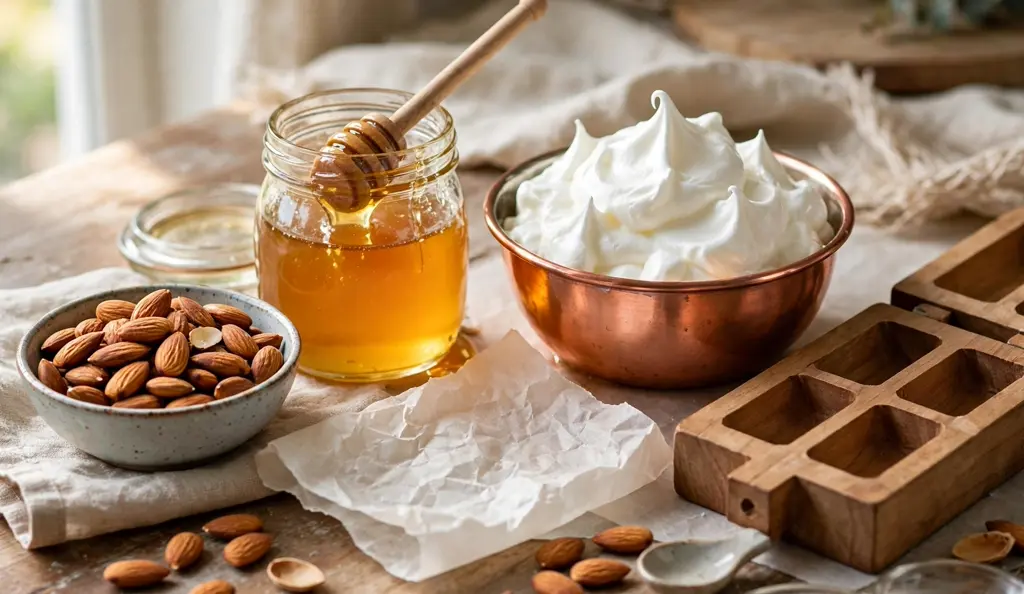
- 250 g blanched almonds, plus a handful extra for the top
- 200 g honey (a floral one like orange blossom works best)
- 150 g white sugar
- 1 large egg white, at room temperature
- Pinch of salt and a few drops of lemon juice
- Optional: 1 teaspoon cinnamon or lemon zest
- Toast the almonds at 175 C (350 F) for 8 to 10 minutes until golden and fragrant. Keep them warm in the turned-off oven.
- Warm the honey in a heavy pan over medium-low heat until it bubbles gently. Stir in the sugar and salt.
- Cook the syrup to 120 C (248 F) on your thermometer. This is the firm-ball stage and it sets the texture.
- Whisk the egg white with the lemon juice to soft peaks. Pour the hot syrup in slowly while whisking.
- Return the mix to low heat. Stir for 8 to 10 minutes until thick and glossy like marshmallow fluff.
- Fold in the warm almonds. Work fast, because the mix firms as it cools.
- Press into a parchment-lined small loaf pan. Smooth the top, scatter the extra almonds, and chill 4 hours.
- Slice with a sharp knife dipped in hot water. Store as described below.
Skip store-bought wafer paper unless its label clearly says gluten free. Most baking wafer paper is potato starch based, but cheap brands vary. Parchment paper works fine as a liner and peels away cleanly.
How to Serve and Store Turrón Like a Spaniard
Spaniards never eat turrón straight from the box like a candy bar. They cut it into small fingers or squares and set it on the table after dinner with coffee. Hard Alicante gets broken into rough chunks. Soft Jijona gets sliced thin, almost like cheese.
Pair hard turrón with strong espresso or hot chocolate. The bitterness balances the honey sweetness. Soft Jijona loves a glass of sweet Moscatel wine or a cup of spiced tea. On a dessert board, turrón sits happily next to dried figs, marcona almonds and dark chocolate. Mexican holiday tables follow a similar sweets tradition, so our gluten free Mexican desserts guide makes a natural companion read.
Storage is simple. Keep both types at cool room temperature in an airtight container, away from heat and sunlight. Do not refrigerate soft Jijona for more than a day, because the cold dulls its flavor. Eat opened bars within two to three weeks for the best texture. Buy in October 2026 and a sealed bar keeps easily through Christmas if you store it right.
What is in each bite: turrón nutrition
Turrón is a treat, not a health food, but its nutrition is honest. A typical hard almond turrón delivers about 549 calories per 100 grams, with 36 grams of fat and 13 grams of protein (Open Food Facts, from labeled product data). The almonds supply most of that protein plus vitamin E and magnesium. The sugar and honey supply the energy, roughly 30 to 40 grams of sugars per 100 grams depending on the brand.
One serving is small. Two thin fingers weigh about 25 to 30 grams and land near 150 calories. That portion also gives you a real handful of almonds, which beats most Christmas candy on protein. People managing blood sugar should treat it like any sweet and keep portions small.
Turrón Questions, Answered
Is turron gluten free?
Traditional turrón made from almonds, honey, sugar and egg white is naturally gluten free. Chocolate and wafer-containing varieties need a label check, because wheat wafers, malt flavoring and shared factory lines can add gluten.
Is turrón de Jijona gluten free?
Yes, in almost all cases. Jijona is the soft turrón made from ground almonds, honey, sugar and egg white, and it usually has no wafer sheets. Check the label for added flavorings, then enjoy.
Is turrón de Alicante gluten free?
The nougat itself is gluten free, but Alicante bars usually carry wafer sheets on both faces. Traditional Spanish wafers use potato starch and are safe. Read the wafer line, and skip bars whose wafer lists wheat flour.
Does turrón contain wheat?
Classic Spanish turrón does not contain wheat. Some wafers on Alicante bars and some turrón-style candies made outside Spain do. Always read the full ingredient list and the allergen statement.
Is turrón the same as nougat?
Turrón is the Spanish and Mediterranean version of nougat. French and Italian nougats share the same honey, egg white and nut base. Turrón stands apart because of its almond focus and its Christmas tradition in Spain.
What does turrón taste like?
Hard Alicante tastes of toasted almond and floral honey with a crisp snap. Soft Jijona tastes richer and almost like almond marzipan, with a crumbly melt. Both finish sweet but not sticky.
Is turrón vegan?
No. Traditional turrón contains honey and egg white, so it is not vegan. A few modern brands make vegan versions with aquafaba or syrups instead, but they are rare. Check the label.
Is turrón dairy free?
Classic turrón is dairy free, since the recipe has no milk or butter. Chocolate turrón often contains milk, and some flavored bars add milk powder. Read the label if dairy matters to you.
How long does turrón last?
An unopened bar keeps for months past its best-before date when stored cool and dry. Once opened, eat it within two to three weeks. Soft Jijona dries out faster than hard Alicante.
Can you freeze turrón?
You can, but you do not need to. Wrap the bar tightly and freeze for up to three months. Thaw at room temperature for a few hours. Freezing can dull the crunch of hard Alicante slightly.
Where can I buy gluten free turrón?
Spanish grocery stores, Latin markets and online Spanish food shops sell the widest range from October through December. Look for “sin gluten” on the pack. In the US, specialty importers and large online retailers carry certified options.
Is chocolate turron gluten free?
Sometimes. Plain chocolate and almond bars are often fine, but chocolate turrón with puffed rice, cookie pieces or malt flavoring can contain gluten. Choose bars with a gluten free label and simple ingredients.
Is turrón safe for nut allergies?
No. Turrón is mostly almonds, typically 60 percent or more of the bar. It is one of the least safe sweets for anyone with a tree nut allergy. Keep it far from nut-free holiday tables.
How do you pronounce turrón?
Say “too-RROHN” with a rolled R. The accent on turrón falls on the last syllable. In Catalan it is called torró, pronounced “too-ROO.”
The Sweet Takeaway
Turrón earns its place on your holiday table. The classic almond, honey and egg white recipe is naturally gluten free, and soft Jijona is the simplest safe pick. The wafer on hard Alicante bars deserves one careful label read, since potato starch wafers are safe but wheat wafers are not. Buy labeled bars in October and November, store them cool and dry, and you will serve a centuries-old Spanish Christmas sweet with total confidence.
For the full history of this Mediterranean nougat, from its Moorish roots to the modern PGI grades, the encyclopedia entry is a solid starting point.